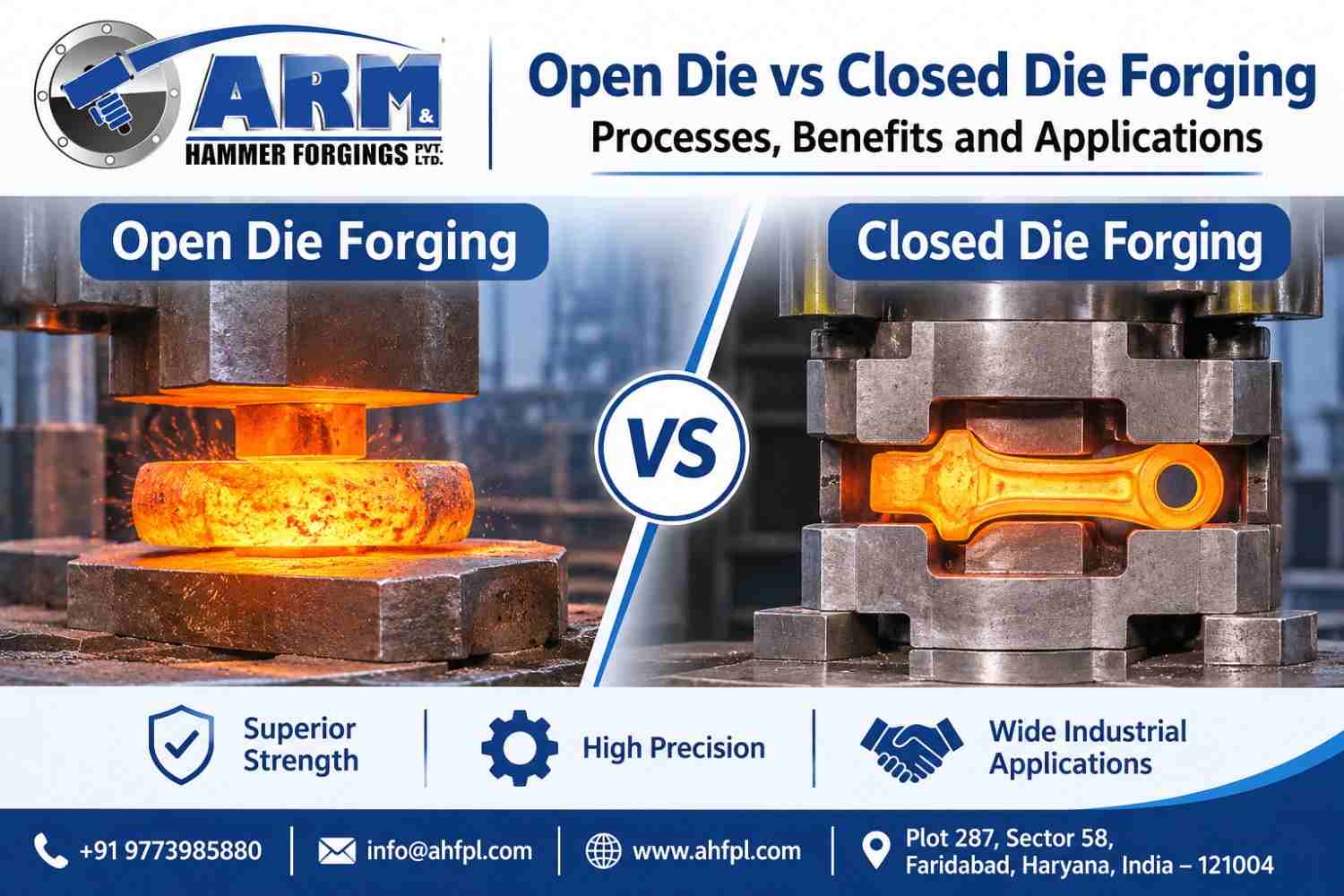
It is crucial to know the differences between open die forging and closed die forging for choosing the best process to manufacture parts for various industries. Both processes utilize compressive forces to change the form of metals, but they have distinctions in terms of dies, production process, shape, number of components produced, and cost.
Open die forging is applicable for manufacturing large and simple parts, while closed die forging is preferable for producing components that have a specific shape and complicated geometries. Both processes are widely applied in the automotive industry, railway, mining, agriculture, construction, and many others.
We at Arm & Hammer Forgings Pvt. Ltd. specialize in closed die forging and CNC machining for manufacturing industrial components according to customer drawings and specifications.
What Is Open Die Forging?
Open die forging refers to a forging operation where the heated metal is deformed between two dies, which do not totally enclose the workpiece. Compression of the heated metal takes place through the use of either a forging hammer or a hydraulic press.
The open die forging method gives the metal an opportunity to flow in areas that are not restricted by the dies. It is normally applied in the production of parts like shafts, rings, cylinders, and others with simple geometry.
Open Die Forging Process
Generally, in an open die forging operation, the metal billet chosen is subjected to heating up to the necessary temperature level. It is then placed between two dies and compressed by a hammer or press. This goes on until the part takes the desired shape. The part can then go for processes such as cooling, heat treating, and machining.
The open die forging process generally involves:
- Material Selection: Materials that suit the job, such as carbon steel and alloy steel, are chosen.
- Heating: The metal billet is heated to its forging temperature.
- Deformation: The metal billet is deformed by compressing it between open dies using a hammer or press.
- Shaping: The metal billet is repositioned several times for the required shape and size.
- Finishing: The metal billet is cooled, heat-treated, and machined as necessary.
Advantages of Open Die Forging
- Appropriate for large and heavy metal pieces.
- It requires simpler and economical tooling.
- It is appropriate for small production runs.
- It is flexible with respect to piece sizes and shapes.
- Appropriate for customised industrial products.
Applications of Open Die Forging
Open die forging technique is widely applied in the manufacture of large shafts, rings, cylinders, discs, pressure vessel parts, and heavy machinery components. This method is highly applicable in industries where large custom forgings are required.
What Is Closed Die Forging?
Closed die forging is a manufacturing process where heated metal is squeezed into shape using dies that have been carefully engineered to contain the desired shape of the part. This causes the metal to flow into the shape of the die, thus creating a part of the desired shape.
The process of closed die forging is commonly employed in the manufacture of industrial parts that require strength and accuracy.
Closed Die Forging Process
In the closed die forging process, one needs to first choose and cut the required metal into the form of billets. These billets are heated to the required forging temperature and then put in the lower die. Pressure is applied by the upper die through a forging hammer or a press, causing the metal to occupy the die cavity.
The number of operations may vary according to the design of the component. After forging, the extra metal is trimmed off, and the components are cooled, heat-treated, blast cleaned, CNC machined, and inspected wherever necessary.
The closed die forging process generally involves:
- Material Preparation: Select and cut the raw material as per the requirements of the components.
- Heating: Heat the billet up to the forging temperature.
- Die Preparation: Forging dies are made as per the drawing of the components.
- Forging: The hot billet is compressed into the die cavity to attain the desired shape.
- Trimming and Finishing: Cut the excess material and perform heat treatment, CNC machining, and inspection when needed.
Advantages of Closed Die Forging
- Shapes complex components.
- Ensures excellent dimensionality.
- Facilitates good grain flow and mechanical properties.
- Appropriate for repetitive and high-volume production.
- Helps minimize wastage of materials through suitable designs.
- Also allows manufacturing customized industrial parts.
Applications of Closed Die Forging
Closed die forging is extensively employed in many industries including automobiles, railways, mining, agriculture, military, and mechanical industries. Some of the items manufactured through closed die forging are shafts, gears, connecting rods, control arms, yokes, flanges, valves, and other industrial products.
Key Differences Between Open Die and Closed Die Forging
Diagram Image of Open vs. Closed Die Forging:
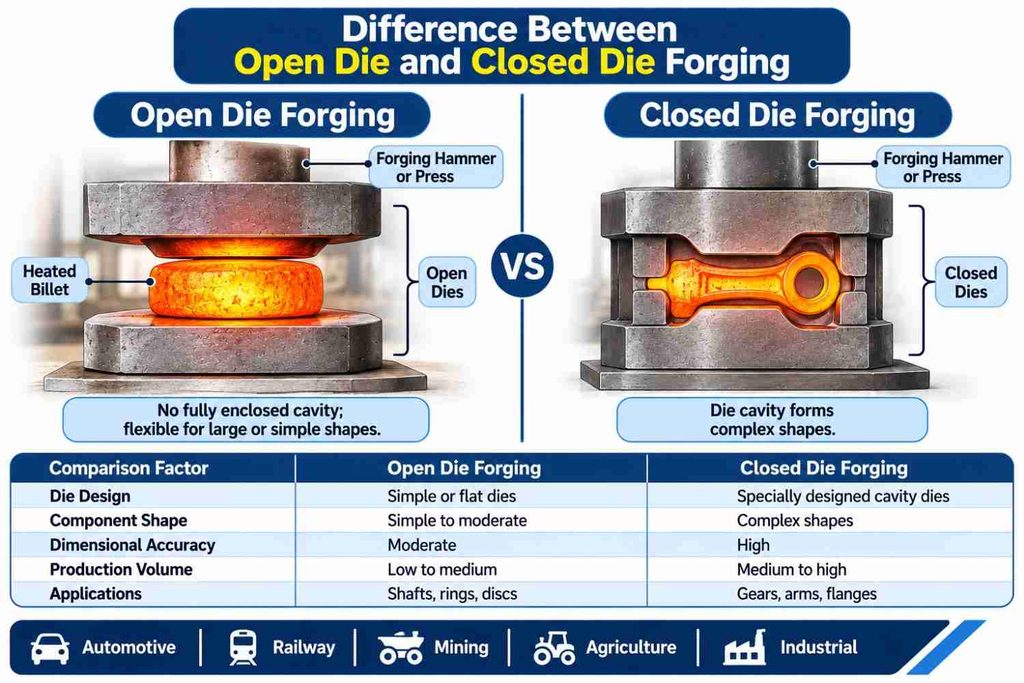
Both manufacturing processes offer different advantages depending on the product design and production requirements.
| Comparison | Open Die Forging | Closed Die Forging |
| Die design | Simple dies | Specially designed shaped dies |
| Component shape | Simple geometries | Complex geometries |
| Production quantity | Small batches | Medium and high volumes |
| Dimensional accuracy | Generally lower | Generally higher |
| Tooling cost | Relatively low | Higher initial investment |
| Material flow | Less geometrically restricted | Controlled by die cavity |
| Material wastage | Can be higher | Generally better material utilisation |
| Applications | Large shafts, rings, cylinders | Gears, shafts, yokes, connecting rods |
The main difference is that open die forging shapes metal between dies that do not completely enclose the workpiece, while closed die forging uses shaped cavities to produce the required component geometry.
Which Forging Process Is Better?
Selection between open die and closed die forging lies in component sizes, complexity of designs, volume of production, material considerations, and cost of manufacturing.
Open die forging would be the best choice for larger-sized components, customized components, and small production volumes where special dies may be expensive. Closed die forging would be better suited for components that need precise dimensions and repeated production.
For instance, forging of large industrial shafts and heavy rings takes place using open die forging, while forging of gear blanks for automobiles, railway yokes, control arms, and many other components is best done using closed die forging.
Industrial Applications of Open Die and Closed Die Forging
Forged components are an important part of current industrial manufacturing. Each process is suitable for fulfilling particular engineering needs.
- Automotive industry – gear blanks, shafts, connecting rods, transmission components.
- Railway industry – yokes, yoke shafts, control arms, links, levers.
- Mining industry – crusher hammers, beater arms, track components, and machinery components.
- Oil and gas industry – forged flanges, valve bodies, forged elbows.
- Agriculture industry – axle shafts, rocker shafts, and agricultural machinery components.
- Power generation – industrial shafts and mechanical components.
Selection of the right forging manufacturing process can enhance the performance and reliability of manufactured components.
Why Choose Arm & Hammer Forgings Pvt. Ltd.?
Arm & Hammer Forgings Pvt. Ltd. is an Indian company based in Faridabad that is involved in manufacturing forging and CNC machining products for many different industries.
We manufacture industrial components using carbon steel, alloy steel, and stainless steel according to customer drawings, material specifications, and application requirements.
Our product range includes:
- Forged gear blanks & forged precision gears
- Railway yokes & yoke shafts
- Control arms & forged links
- Mining crusher hammers & beater arms
- Forged shafts & mechanical components
- Forged flanges & valve bodies
- Agricultural and Industrial Forgings components
We have our manufacturing unit comprising forging hammers, CNC VMC machining centers, CNC lathes, a heat treatment facility, and our own in-house forging dies manufacturing shop. Our forged components are manufactured in the range of approximately 1 Kg to 150 Kg.
Being a closed die forging component manufacturer in India, our emphasis is on product quality, accuracy, and customers’ specific requirements.
If you are a business looking for an open-die forging components manufacturing company or forging company in India, make sure that you consider the capacity of the manufacturing company when choosing the right one. Our expertise lies in closed die forging and CNC machining for those who need reliable industrial forged components.
Conclusion
Both open die forging and closed die forging are popular metal forming techniques used in modern manufacturing industries. Open die forging is ideal for large products and custom manufacturing, whereas closed die forging provides superior dimensional control and accuracy and is better suited for complex industrial components.
Proper selection of the forging manufacturing process increases the quality, manufacturing efficiency, and performance of the product.
Arm & Hammer Forgings Pvt. Ltd. specializes in closed die forging and CNC machining services for various industrial applications such as automobile, rail, mining, agriculture, defense, etc. Please contact us for customized forging components manufactured as per your specifications.
Frequently Asked Questions (FAQs)
Q 1. What is the difference between open die forging and closed die forging?
The metal is shaped in open die forging by using dies that do not fully cover the material. The closed die forging process makes use of specially designed cavities in the dies for shaping the components.
Q 2. What is the preferred type of forging for industrial components?
While closed die forging is applicable to complex components and repetitive production processes, open die forging is usually preferred for large and complex components.
Q 3. What are some products made using closed die forging?
Some common products made using closed die forging include gear blanks, shafts, connecting rods, railway components, control arms, flanges, and industrial machine components.
Q 4. What materials can be forged?
Materials commonly used include carbon steel, alloy steel, stainless steel, and other appropriate materials depending on the requirements of the component.
Q 5. What company specializes in manufacturing closed die forging components in India?
Arm & Hammer Forgings Pvt. Ltd., located in Faridabad, Haryana, specializes in closed-die forging components and CNC-machined industrial components.