
Introduction
Forging is one of the most common metalworking manufacturing techniques. The forging processes involve forming metal using compressive forces applied by hammers, presses, and dies. The forged parts are frequently used in the automobile industry, railway, mining, agricultural, construction, and oil & gas industries due to the strength, durability, and effectiveness of their performance.
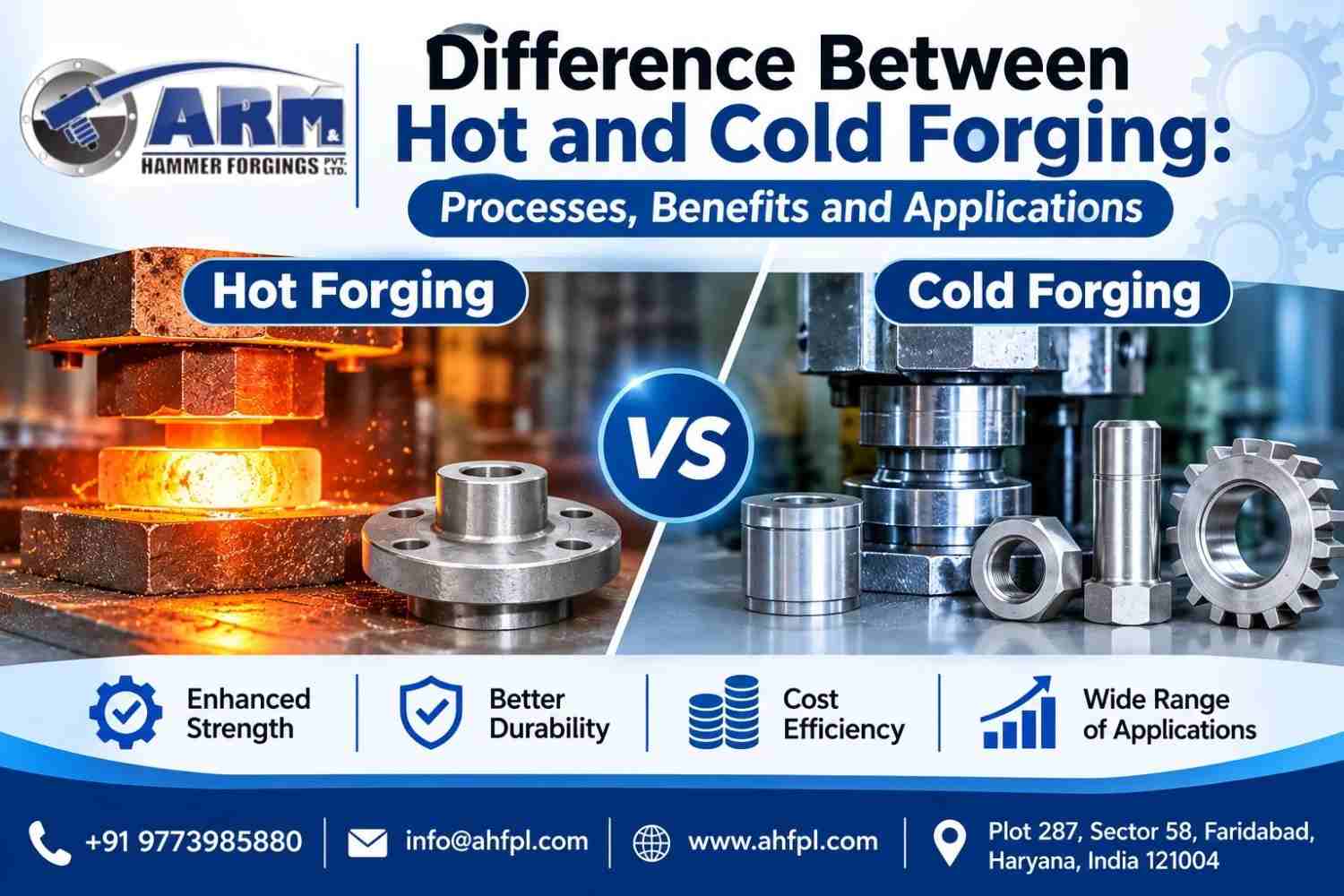
Hot forging and cold forging processes are two of the main forging techniques. Even though both of them entail the shaping of metals into certain shapes, there are distinctions between the two processes in terms of temperatures, properties of materials, production procedures, and applications. Understanding these differences helps manufacturers select the right process for producing high-quality industrial components.
What Is the Hot Forging Process?
The hot forging process involves shaping a workpiece of metal at a temperature higher than its recrystallization temperature through compressive forces. The heat treatment makes the metal soft and malleable such that it can be easily shaped using low amounts of forming forces. The workpiece of metal is then positioned between forging dies or under a forging hammer/press and is molded to shape.
The temperature at which hot forging is performed is dependent on the metal grade, the chemical makeup of the metal, and the level of deformation necessary. Hot forging for steel usually takes place at high temperatures, specifically around 950°C and 1,300°C, but the appropriate temperature would vary per metal and forging process. During the process of deformation, the metal may also recrystallise itself to avoid strain hardening.
Hot Forging Processes
There are many well-controlled manufacturing stages involved in the hot forging process. Firstly, the right raw material is selected by the manufacturer depending on the drawing of the component, its mechanical properties, and material standards. The material is later machined into billets/blanks of the required size. This ensures that material consistency is maintained and wastage is minimized.
The hot forging process generally involves the following steps:
- Material Selection: The proper selection of materials is made, which may include carbon steel, alloy steel, or stainless steel.
- Heating: The metal billets are heated to the required forging temperature.
- Forging: The heating process is followed by shaping with the help of forging hammers/presses and dies.
- Cooling: The forged component is cooled under appropriate conditions.
- Finishing: Trimming, heat treatment, shot blasting, and CNC machining are some of the finishing operations.
Advantages of Hot Forging
- Enhanced ductility of the material: Increased temperature raises the ductility of the metal and allows it to deform without breaking, which makes it possible to deform the metal extensively.
- Increased ease of shaping: Hot metal usually requires smaller deformation forces compared to cold working of the same material.
- Production of various shaped components: It can form different types of shapes such as shafts, gears, flanges, and even industrial components.
- Proper grain orientation: It is possible to create a proper grain orientation in accordance with the shape of the component.
- Suitability for manufacture of large components: It is especially advantageous when it comes to the production of heavy and medium industrial parts.
- Prevention of strain hardening during deformation: The recrystallization phenomenon allows avoiding excessive work hardening of the material.
Applications of Hot Forging
The hot forging process is commonly applied in the making of automobile shafts, gear forgings, connecting rods, railroad parts, mining machinery components, flange forgings, and industrial valve bodies. Such components are designed to operate under heavy working conditions and mechanical stress.
What Is the Cold Forging Process?
Cold forging is a metalworking operation carried out at or near room temperature. As opposed to hot forging, the metal does not need to be heated to high temperatures before shaping. It is not forced into a mold but pressed into a specially designed die by mechanical pressure to achieve the required shape.
Cold forging is often used to produce small, accurate, and consistent parts. It is especially suitable for high-volume production where dimensional accuracy and surface finish are important.
Cold Forging Processes
The cold forging process starts with the choice of a suitable raw material. This is normally steel, aluminum, or some other metal grade with sufficient formability. Raw material is normally delivered in bars, rods, wires, or prepared blanks. The surface condition and material properties have to be controlled. Surface defects or unsuitable material characteristics can affect the final component.
Depending on the grade of metal and the requirements of the manufacturing process, the material may be cleaned, surface treated, lubricated, or otherwise prepared prior to forming. Operations like this help to reduce friction between the tooling and the workpiece. Proper lubrication is particularly important because cold forging involves considerable contact pressure between the metal and the dies.
The blank thus prepared is then put into a specially designed die. Then a mechanical or hydraulic press applies a lot of force to push the metal into the shape it needs to be. Depending on the component, the process may involve upsetting, extrusion, heading, or other forming operations. For some products, more than one forming stage is needed to achieve the final geometry without damaging the material.
The component is inspected after removal from the forming operation. Other operations can include trimming, heat treating, threading, surface finishing, or precision machining depending on the application. Because cold forging can produce close dimensional tolerances, some components may require less machining than similar parts forged hot. But the amount of finishing required depends on the design and specifications.
Advantages of Cold Forging
- High dimensional accuracy: Close dimensional tolerances can be attained by cold forging if the tooling and process conditions are properly controlled.
- Improved surface finish: Typically, the lack of high-temperature oxidation and scale formation produces a cleaner surface.
- Work hardening: Some metals can be strengthened and hardened by plastic deformation.
- Material efficiency: Near-net-shape manufacturing can eliminate material waste and machining requirements.
- High production rates: Automated cold-forging machines can make large numbers of repeatable parts.
- Low heating needs: The process does not need the high-temperature heating of the billet like in the case of conventional hot forging.
Applications of Cold Forging
Cold forging is widely used for the production of bolts, nuts, screws, pins, rivets, automotive fasteners, electrical connectors, and other precision metal parts.
Key Differences Between Hot Forging and Cold Forging Processes
Both processes offer different manufacturing advantages. The following table highlights their major differences.
| Comparison Factor | Hot Forging | Cold Forging |
| Processing temperature | Above recrystallisation temperature | At or near room temperature |
| Material condition | Heated and more ductile | Relatively hard and less ductile |
| Forming force | Generally lower | Generally higher |
| Surface finish | May have oxidation and scale | Generally smoother and cleaner |
| Dimensional accuracy | Depends on cooling and process control | Generally higher |
| Material deformation | Suitable for large deformation | More limited by material ductility |
| Grain behaviour | Recrystallisation can refine the grain structure | Work hardening occurs |
| Tooling requirements | Must withstand heat and forging loads | Must withstand high forming pressure |
| Component size | Suitable for medium and large components | Commonly used for smaller components |
| Production suitability | Wide range of component sizes and shapes | High-volume production of suitable parts |
| Heating requirement | Requires billet heating | Usually no high-temperature heating |
| Additional machining | May be required for final dimensions | Can often reduce machining requirements |
Which Forging Process Is Better?
The decision on whether to use hot forging or cold forging depends on the nature of the product’s material, size, design, and purpose. Hot forging is typically recommended where large-scale industrial products need to undergo considerable shaping and reliable mechanical performance.
Some of the examples of hot forgings include forged shafts, gear blanks, and mining components. However, where smaller components need to have very precise sizing and smooth finishes, cold forging is the best method of making them.
Bolts and fasteners are some examples of cold forgings. Consequently, an appropriate manufacturing process should be determined based on the customer’s specifications and requirements.
Industrial Applications of Forged Components
Forged components are essential in several industries because of their strength and durability.
- Automotive Industry: Forged shafts, connecting rods, gears, and transmission forgings.
- Railways Industry: Yokes, yoke shafts, control arms, links, and levers.
- Mining: Crusher hammers, beater arms, track parts, and other industrial parts.
- Oil and Gas Industry: Forged flanges, valve bodies, and forged elbows.
- Agriculture: Axle shafts, rocker shafts, and other components for agricultural machines.
- Power generation: Industrial shafts and industrial mechanical parts for power machines.
Why Choose Arm & Hammer Forgings Pvt. Ltd.?
Arm & Hammer Forgings Pvt. Ltd. is a leading forging and machining firm operating in Faridabad, Haryana, India. Our specialty lies in producing closed-die forgings and CNC machining services for different industrial applications.
The manufacturing facilities available at our company comprise closed-die forging, CNC machining, heat treatment, and forging die manufacturing. We utilize carbon steel, alloy steel, and stainless steel in manufacturing components as per the requirements of our clients.
Our range of products comprises forged gear blanks, shafts, railroad components, control arms, mining components, crusher hammers, beater arms, flanges, and valve bodies.
As a hot forging components manufacturer in India, we concentrate on providing reliable industrial components through careful consideration of material, accuracy of dimensions, and the requirements of our customers.
Companies that are seeking a cold forging component manufacturer or a hot and cold forging company should consider evaluating the production capability of the firm before making any decisions. Our specialty lies in closed-die forging and CNC machining.
Contact Arm & Hammer Forgings Pvt. Ltd.
- Address: Plot 287, Sector 58, Faridabad, Haryana, India – 121004
- Phone: +91 9773985880
- Email: info@ahfpl.com
- Website: https://ahfpl.com/
Conclusion
Hot and cold forging are both important metalworking forging processes that have their own merits and uses. Hot forging is ideal for large pieces and difficult shapes to forge, whereas cold forging provides good precision and surface finish.
The choice of proper forging process depends on various factors, including the nature of the material, the design of the part, and its use. Arm & Hammer Forgings Pvt. Ltd. offers services for closed die forging and CNC machining for industries requiring quality forgings in India.
Frequently Asked Questions (FAQs)
1. What is the primary distinction between hot forging and cold forging?
Ans. Hot forging involves the shaping of metals in a heated state, whereas cold forging involves the shaping of metals at room temperature under mechanical pressure.
2. Which method of forging is superior?
Ans. The hot forging process works best for large and complex components, while cold forging works best for small and precision components.
3. What materials are commonly used in hot forging?
Ans. They include carbon steel, alloy steel, and stainless steel.
4. What products are commonly made through the cold forging process?
Ans. Some of the common products include bolts, nuts, screws, pins, rivets, fasteners, and electrical connectors.
5. Who is a hot forging component manufacturing company in India?
Ans. Arm & Hammer Forgings Pvt. Ltd., located in Faridabad, Haryana, specializes in closed-die forged components and CNC-machined industrial components.