When dealing with high-pressure piping systems, pumps, and industrial valves, the integrity of your connection points is non-negotiable. Forged flanges are the gold standard for these critical junctions. Unlike cast alternatives, the extreme heat and pressure of the forging process align the steel’s grain structure, eliminating internal voids and delivering superior impact resistance and sheer strength.
Whether you are designing a new refinery pipeline or sourcing components for a specialized industrial facility, understanding the exact technical specifications of forged flanges is crucial. Here is a comprehensive breakdown of flange types, dimensional standards, and material grades.
1. Primary Forged Flange Types
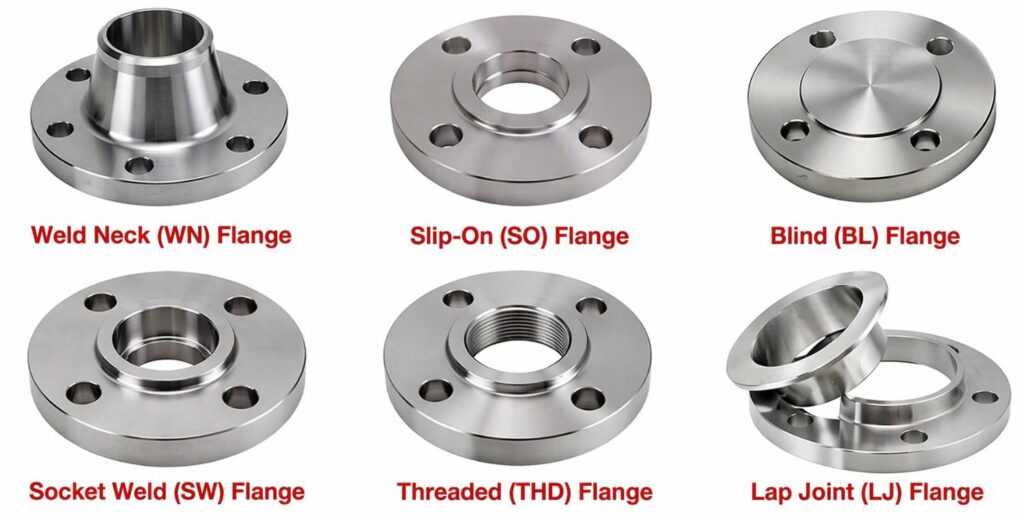
The specific design of a carbon steel flange determines how it connects to the pipe and the type of mechanical stress it can withstand. The most common configurations include:
- Weld Neck (WN): Engineered with a long, tapered hub that is butt-welded directly to the pipe. This design smoothly transfers stress from the flange to the piping, making it the premier choice for high-pressure, high-temperature, and hazardous industrial applications.
- Slip-On (SO): These flanges slide directly over the pipe and are fillet-welded on both the inside and outside. While they are easier to align than weld neck flanges, their lower fatigue strength generally restricts them to lower pressure systems.
- Blind (BL): A solid steel plate used to seal the end of a piping system or valve. Blind flanges are subjected to immense bending stresses at their center and are critical for safe line isolation.
- Socket Weld (SW): Designed for smaller diameter pipes (typically NPS 2 and below). The pipe is inserted into a socket and fillet-welded on the exterior, making it ideal for tight spaces where internal welding is impossible.
- Threaded (THD): Featuring internal threads, these flanges can be attached without welding. They are often utilized in highly explosive environments where welding is a hazard, though they are not recommended for high-temperature cyclic applications.
- Lap Joint (LJ): A two-part system featuring a stub end (welded to the pipe) and a loose backing flange. This allows for easy rotation and bolt alignment, perfect for systems that require frequent dismantling.
2. Pipe Flange Dimensional Standards and Pressure Classes
Global interchangeability relies on strict dimensional standards. These standards dictate the outer diameter, bolt hole circle, flange thickness, and pressure-temperature ratings.
| Standard Body | Primary Standard | Size Range | Common Pressure Classes |
| ASME / ANSI | B16.5 | NPS ½” to 24″ | Class 150, 300, 400, 600, 900, 1500, 2500 |
| ASME / ANSI | B16.47 (Series A/B) | NPS 26″ to 60″ | Class 75, 150, 300, 400, 600, 900 |
| EN / DIN | EN 1092-1 | DN 10 to DN 4000 | PN 10, 16, 25, 40, 63, 100, 160 |
| API (Oil & Gas) | API 6A | 1 13/16″ to 30″ | 2000 to 20,000 PSI |
3. Material Specifications (ASTM Standards)
The chemical composition of a forged pipe flange must perfectly match the fluid, temperature, and environmental demands of the system it serves.
- Carbon Steel (ASTM A105 / A105N): The industry workhorse for standard ambient to high-temperature service. The “N” indicates the steel has been normalized for enhanced toughness.
- Low-Temperature Carbon (ASTM A350 LF2/LF3): Specifically alloyed to maintain notch toughness and prevent brittle fractures in sub-zero environments.
- Stainless Steel (ASTM A182 F304/L, F316/L): Utilized when high corrosion resistance and long-term durability are required, particularly in chemical processing or food-grade applications.
- Alloy Steel (ASTM A182 F11, F22, F91): Designed for extreme high-temperature environments, such as steam lines in power generation, where creep resistance is paramount.
4. Flange Facing Types
The “facing” is the machined surface where the gasket sits. Selecting the right facing ensures a blowout-proof seal.
- Raised Face (RF): The most prevalent style. The sealing surface sits above the bolting circle, concentrating pressure onto a smaller gasket area for a tighter seal.
- Flat Face (FF): The mating surface is flush with the bolting circle. Use this when mating with cast iron flanges to prevent the brittle cast material from cracking under bolt tension.
- Ring Type Joint (RTJ): Features a deep, precision-machined groove that houses a metal ring gasket. This is the standard for high-pressure (Class 600+) and extreme temperature applications.
5. The Precision Forging Process
At ARM & Hammer Forgings, we know that the reliability of a Forged Flanges comes down to the integrity of the manufacturing process. For facilities specializing in forged components specifically in the 1kg to 150kg range, the focus remains strictly on the metallurgical perfection of the parts themselves, rather than machinery manufacturing.
The process involves:
- Billet Heating: Workers cut raw steel into precise weights and heat it to optimal forging temperatures (often exceeding 1200°C).
- Closed-Die Forging: For components ranging from 1kg up to 150kg, closed-die drop forging ensures high structural integrity and dimensional consistency.
- Heat Treatment: Operators apply normalizing, quenching, and tempering to achieve the required mechanical properties.
- CNC Machining: Technicians machine the raw forging to exact ASME or DIN dimensional tolerances, including the facing and weld bevels.
- NDT Inspection: Rigorous Non-Destructive Testing (like Ultrasonic or Magnetic Particle Inspection) guarantees zero internal defects.
When engineering a high-performance piping system, specifying the exact flange type, material, and dimensional standard is the only way to ensure long-term safety and operational efficiency.
Forged Flanges Manufacturer and Supplier in India
Arm and Hammer Forging Pvt. Ltd. stands as a reliable forged flanges manufacturer and supplier in India, delivering high-grade steel forged flanges for diverse industrial needs. The company ranks among the leading forging companies in India and consistently manufactures and supplies superior-quality forged flanges for multiple applications. As a renowned forged flanges manufacturer in India, it uses state-of-the-art forging technology to produce components that meet ASTM, ASME, and DIN standards.
Based in Faridabad, Arm & Hammer offers a wide range of forged flanges in Faridabad, including weld neck, slip-on, blind, socket weld, and threaded flanges. The company uses premium materials such as carbon steel, stainless steel, and alloy steel to ensure strength, durability at extreme temperatures, and high resistance to corrosion. Industries such as oil & gas, petrochemicals, power generation, construction, and heavy engineering widely use these pipe forged flanges in Faridabad for their reliability and performance.
The company has a great reputation among clients all over India for delivering on time, having competitive prices, and putting the customer first. They are a reliable supplier for all forged flanges in Faridabad and beyond, whether you need standard sizes or custom solutions.